The Incas
The founders of the Inca Empire, Manco Capac and Mama Ocllo lived on Ganymede (Jupiter’s moon) for a while receiving knowledge and instructions before returning to earth after their training was done.
They were placed then in Lake Titicaca before starting their journey to find the best place to initiate the empire by sinking a golden rod into the ground.
The incas expanded their territory from Cusco into what is now part of Colombia, Ecuador, Peru, Bolivia, Chile and Argentina.
They absorbed the conquered people into their reign and where they failed to conquer, they married the local queen.
Their government had 30 million of people with over 30 different languages under control where there was such organization that there was no hunger, everyone had to work certain hours for the common good and they can receive anything they needed, same system as the Extraterrestrials brothers have.
They kept all knowledge, organization, inventory, rules, reports, etc using nodes of different colors called quipus. The quipus numerical value could have decimals up to 10,000.
They excelled in Engineering, Astronomy and performing brain surgery. Skulls have been found where brain surgery has been performed and people survived many years afterwards.
They relied on daily reports by using running messengers called Chasquis that run up to 300 km (190 miles) per day. Placed on relay stations every 2.5 km (1.6 mile). (3)
A Vast road network was built by them covering 40,000 km (~28,800 miles) used to transport armies, goods and messages.
When Spaniards arrived, there was a war between the last Incas rulers, 2 brothers. Ruins excavations have found that some Incas helped the Spaniards conquer the empire.
The priests and the elite survivors of the empire fled with the empire’s gold and the Solar Disk to Paititi, an intraterrestrial city created by the Great White Brotherhood located in the Amazon jungle. (5)
The Solar Disk is a dimensional door that in the correct vibration state allows you to go through it and connect with another reality. It encodes within it the eternal wisdom of the cosmic and earthly masters. (6)

Legend
“the Sun placed his children in Lake Titicaca, and told them to go wherever they wanted, and that wherever they stopped to eat or sleep, they would have to sink a golden rod into the ground, where that rod would sink with just one hit, the Sun wanted them to stop there and make their home.
Thus, they left the Titicaca Lake and walked north, all the way, wherever they stopped, they stuck the golden rod into the ground and it never sank. They went through a small inn or house, called Paqariq Tampu, and from there they arrived at the valley of Cuzco, which was pure wilderness.
The first stop they made was on the hill called Huanacauri, there Manco Capac tried to sink the gold rod into the ground, which very easily sank at the first blow they gave it, so much so that they no longer saw it.
Then he said to his sister and wife: "In this valley our father, the Sun, commands that we stop and make our seat and dwelling to fulfil his will."
(1)
Empire
“In the early 1200s, under the leadership of Manco Capac, the Inca formed the small city-state Kingdom of Cuzco (Quechua Qusqu). There Manco Capac built a temple to the Sun God, called Inticancha, in the current location of Coricancha.
Over the successive Inca rulers, they expanded their influence beyond Cusco and into the Sacred Valley through a series of battles, marriages, and alliances.”
“the Incas were able to construct "one of the greatest imperial states in human history" without the use of the wheel, draft animals, knowledge of iron or steel, or even a system of writing.
Notable features of the Inca Empire included its monumental architecture, especially stonework, extensive road network (Qhapaq Ñan) reaching all corners of the empire, finely-woven textiles, use of knotted strings (quipu or khipu) for record keeping and communication, agricultural innovations and production in a difficult environment, and the organization and management fostered or imposed on its people and their labor.
The Inca Empire functioned largely without money and without markets. Instead, exchange of goods and services was based on reciprocity between individuals and among individuals, groups, and Inca rulers. "Taxes" consisted of a labour obligation of a person to the Empire.
The Inca rulers (who theoretically owned all the means of production) reciprocated by granting access to land and goods and providing food and drink in celebratory feasts for their subjects.”
“The "indigenous cultures saw the two genders as complementary parts of a whole". In other words, there was not a hierarchical structure in the domestic sphere for the Incas.”
(2)
Children of the Sun
“The Incas, specifically, were brought into existence at Tiwanaku (Tiahuanaco) from the sun god Inti; hence, they regarded themselves as the chosen few, the 'Children of the Sun', and the Inca ruler was Inti's representative and embodiment on earth.”
Roads
“The Inca road network covered over 40,000 km and as well as allowing for the easy movement of armies, administrators, and trade goods, it was also a very powerful visual symbol of Inca authority over their empire.”
Mit’a Service
“As there was no currency in the Inca world, taxes were paid in kind - usually foodstuffs, precious metals, textiles, exotic feathers, dyes, and spondylus shell - but also in labourers who could be shifted about the empire to be used where they were most needed, known as mit'a service. “
(4)
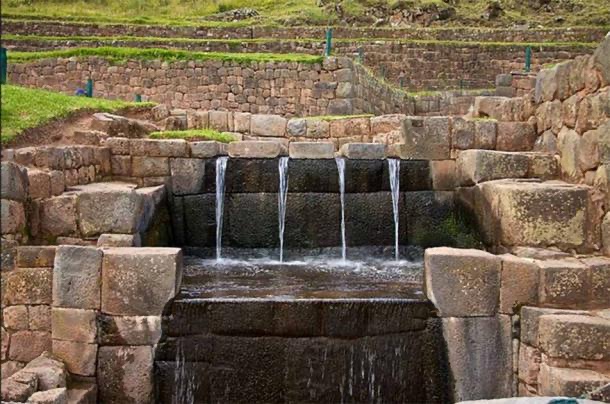
Ancient water spouts at Tipón, Peru (CC BY 2.0). https://www.ancient-origins.net/ancient-places-americas/inca-engineering-0018359
Links
1 History of the Incas
https://en.wikipedia.org/wiki/History_of_the_Incas
2 Inca Empire
https://en.wikipedia.org/wiki/Inca_Empire
3 Chasqui
https://en.wikipedia.org/wiki/Chasqui
4 Inca Civilization
https://www.worldhistory.org/Inca_Civilization/
5 Sun’s Children
https://cosmicsong.org/index.php/papers/suns-children
6 Solar Disk
https://cosmicsong.org/index.php/dictionary/solar-disk
Incan Brain Surgery
https://www.historyisnowmagazine.com/blog/2021/11/19/incan-brain-surgery-an-analysis-of-ancient-neurosurgery
Incas Mastered Brain Surgery with 90% survival https://youtu.be/ALe8-bhaNJ8
10 Jaw-dropping Engineering Marvels of the Inca Empire
https://www.ancient-origins.net/ancient-places-americas/inca-engineering-0018359